The first time you play a riff your friends recognize, guitar stops feeling like an instrument with six confusing strings and starts feeling like your instrument. That is why so many players want to learn songs on guitar right away. It is exciting, motivating, and completely possible – as long as you learn the song in a way that builds real skills along the way.
At Rawk U, we believe students should play music they love early on. But learning songs is not about racing through a chord chart or memorizing a few shapes without knowing what they do. The best path combines favorite songs with steady work on rhythm, technique, listening, and confidence. That is how a beginner becomes someone who can truly play.
Start With a Song You Actually Want to Play
A great first guitar song is not always the easiest song on the radio. It is the one that makes you pick up the guitar again tomorrow.
For a younger student, that may be a movie soundtrack, a modern pop hit, or a classic rock chorus they have heard in the car. For an adult returning to guitar, it could be a blues standard, a 1990s anthem, or the song that made them want to play in the first place. Motivation matters because progress comes from repetition, and repetition is much easier when the music means something to you.
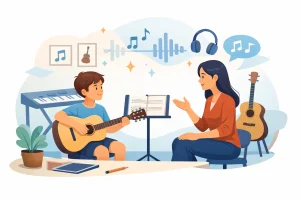
That said, choose the right version of the song for where you are now. You do not need to play every guitar layer from the original recording on day one. A strong teacher can pull out the essential chord progression, main riff, or simplified rhythm part so you can make real music while your hands are still developing.
Playing an accessible version is not cheating. It is how musicians build the skills to tackle the full arrangement later.
Learn Songs on Guitar in the Right Order
Many new players make the same mistake: they begin at the intro, get stuck on one difficult bar, then restart the entire song over and over. It feels like practice, but it is usually frustration wearing a guitar strap.
Instead, break the song into musical jobs. First, listen closely enough to identify the pulse. Then learn the chord shapes or riff notes. After that, work on the rhythm that makes those notes sound like the song. Finally, connect the sections and play along with the recording or a backing track.
Rhythm deserves more attention than it gets. You can play the correct chords, but if they land at the wrong time, the song will not feel right. Start slowly with a metronome, a drum groove, or a teacher counting with you. Clean, steady time at a slower speed beats messy speed every time.
When a chord change gives you trouble, isolate it. Practice moving between those two chords ten times without strumming. Then add a simple downstroke. Then add the song’s actual rhythm. Small wins stack up fast when you stop asking your hands to solve five problems at once.
Give Both Hands a Clear Job
Your fretting hand needs to make clean notes with relaxed pressure. Your picking or strumming hand needs to keep time. Beginners often watch the fretting hand so closely that the rhythm hand freezes. Others strum continuously while the left hand scrambles to catch up.
Slow practice helps the hands become a team. Try holding a chord shape, then strumming four even beats. Switch to the next chord and do the same. If there is buzzing, muted strings, or hand pain, pause and adjust your thumb position, finger angle, and pressure before drilling the mistake into muscle memory.
Good technique is not a boring detour from playing songs. It is what lets you play longer, sound clearer, and avoid the kind of tension that makes guitar feel harder than it needs to be.
Focus on the Parts People Remember
You do not have to conquer every second of a song before it feels rewarding. Start with the hook: the chorus progression, the signature riff, or the groove that makes people immediately know what you are playing.
For example, a simple two- or three-chord chorus may get you singing along within your first few lessons. A famous single-note riff can teach string crossing, alternate picking, and timing without requiring a huge chord vocabulary. Power chords can put newer rock players into a loud, satisfying sound quickly, while also teaching movable shapes across the neck.
This approach gives beginners a musical payoff without ignoring the fundamentals. You are not just collecting songs. You are learning patterns that show up everywhere: common chord changes, eighth-note rhythms, palm muting, pentatonic riffs, and the difference between playing notes and making them groove.
Do Not Let Tabs Do All the Thinking
Tabs can be useful. They show where to put your fingers, and they can help a player get oriented quickly. But tabs do not always tell the whole story. They may leave out rhythm, use an awkward fingering, or miss the subtle details that make a part sound convincing.
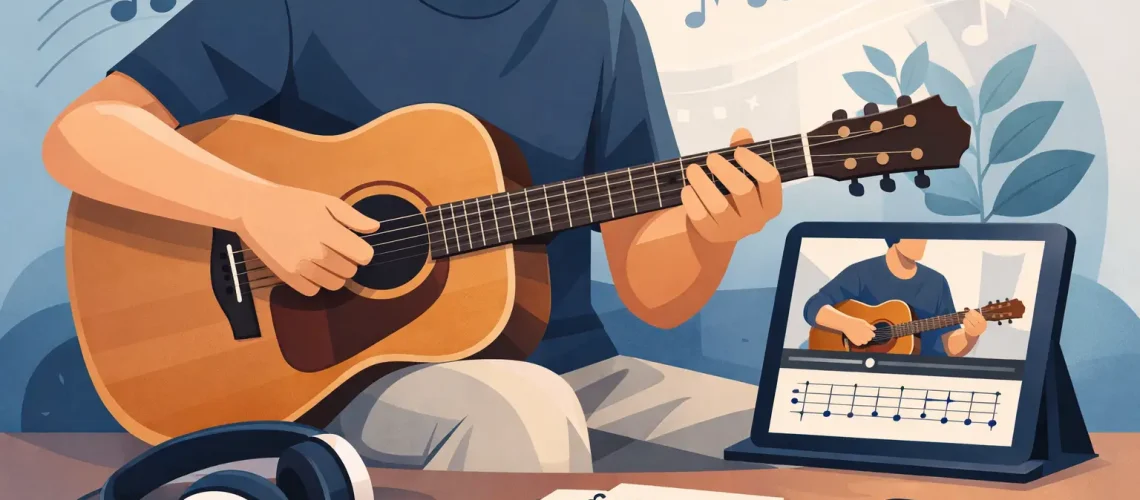
Use your ears along with any written guide. Listen for whether a part sounds bright or heavy, smooth or choppy, open or muted. Notice when the guitar enters and when it gets out of the way. These listening habits help students become musicians who can learn songs beyond the screen.
Basic music reading and theory also make learning faster over time. Knowing the names of your chords, understanding a key, and recognizing a repeated progression gives you a map. You may not need a music theory lecture before playing your first song, but a little knowledge makes every new song less mysterious.
Practice in Short, Focused Rounds
A productive practice session does not need to be an hour of nonstop playing. Fifteen focused minutes can move a song forward when you have a plan.
Begin with a quick warm-up to wake up your hands. Spend a few minutes on the toughest chord change, riff, or rhythm pattern. Then play the section before and after it so the part works in context. End by playing something you already enjoy, even if it is only one verse or chorus.
Keep your guitar where it is easy to reach. This sounds simple, but it changes everything. A guitar in a case across the house is a future practice session. A guitar on a safe stand in your room is an invitation to play for five minutes while dinner is cooking or before homework begins.
Parents can help young players by praising consistency instead of perfection. Ask to hear the new riff. Celebrate the clean chord change that was impossible last week. Performance confidence grows when students learn that mistakes are information, not a reason to quit.
Play With Other People as Soon as You Can
Learning alone builds useful skills. Playing with others teaches skills that cannot be fully learned alone: listening, recovering after a mistake, holding your part, and feeling the shared energy of a song coming together.
That is why band programs and live performance opportunities matter. A student who can play a riff in a bedroom has accomplished something. A student who can play it with a drummer, bassist, vocalist, and audience has learned how music works in the real world.
The stage can feel intimidating at first, especially for children and adult beginners. The answer is not to wait until you feel perfectly ready. It is to prepare in supportive steps: play for your teacher, play with a backing track, rehearse with a group, then perform in a welcoming environment. Each step makes the next one feel more possible.
A Better Goal Than Playing It Perfectly
When you learn a new song, aim for progress you can hear. Maybe today you nail the main riff at half speed. Next week, you hold the rhythm through a full verse. Soon, you play the chorus without stopping. Those are real milestones.
Some songs will take a few weeks. Others will challenge you for months. It depends on the arrangement, your current technique, and how consistently you practice. The point is not to rush past the hard parts. It is to build the tools that make the next favorite song easier to learn.
Pick the song that makes you want to turn the amp on, give each section the patience it deserves, and let yourself be a beginner who plays real music. Then, when you are ready to take that song beyond the practice room, book your FREE Trial Lesson and learn the art of RAWK.