A student nails the opening riff alone in a lesson, then freezes when it is time to play with a drummer. Another loves the energy of a band room but needs more help getting their chords clean. That is why private versus group music lessons is not a simple either-or decision. Both formats can create real musicians, but they develop different parts of a musician’s confidence.
For many families and adult players, the best path is not choosing one forever. It is starting with the support that meets the student where they are, then adding opportunities to play with others when they are ready. Great music education builds skills in the practice room and gives those skills a place to come alive.
What Private Music Lessons Do Best
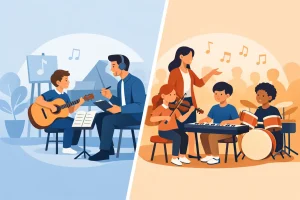
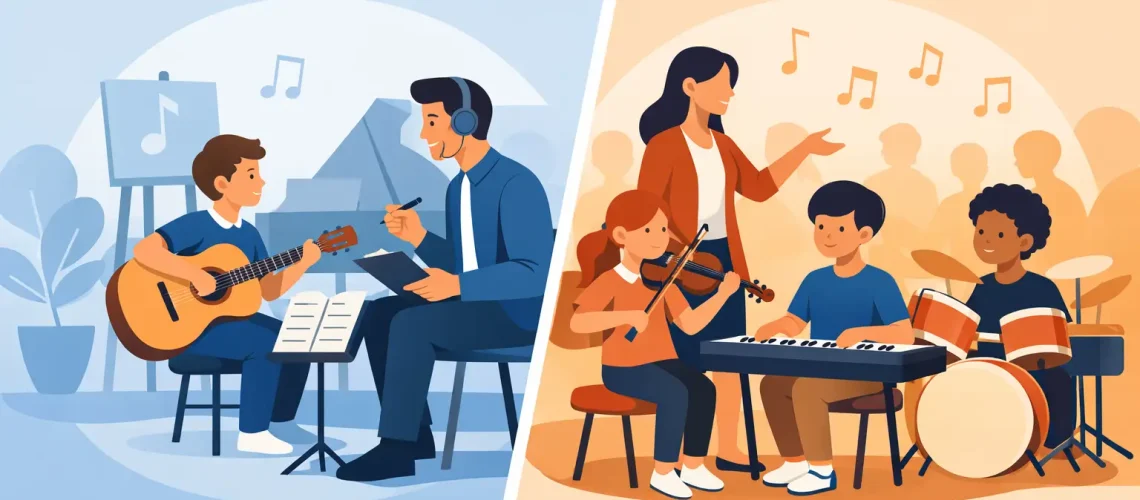
Private lessons give a student something hard to replicate in a group: focused attention. Every minute can be shaped around the player in the chair. If a beginning guitarist is struggling to switch between G and C, the instructor can slow down, adjust hand position, and find a practice approach that works. If a returning adult pianist wants to learn a favorite song but has rusty reading skills, the lesson can balance both goals without making either feel like homework.
That personal pacing matters. Some students race ahead with rhythm but need more time on note reading. Others have a great ear yet need help understanding why certain chords work together. In a one-on-one setting, the teacher can spot small technical habits before they become frustrating roadblocks. Good private instruction covers the foundations – rhythm, technique, theory, reading, chords, and instrument-specific skills – while putting them to work in songs the student actually wants to play.
Private lessons are often the right starting place for complete beginners, younger children who need a calm routine, and students preparing for an audition or specific performance. They also work beautifully for adults who prefer a flexible, low-pressure place to learn. There is no need to arrive already confident. That is what the lesson is for.
The trade-off: less built-in collaboration
A private student can make impressive progress and still have limited experience listening across a room, holding a groove with a drummer, or recovering after a missed note in front of others. Those are performance skills, not just instrument skills. They can be introduced in private lessons, but they grow fastest when students play with people.
That does not make private instruction incomplete. It simply means the student may eventually benefit from a group experience that asks them to use their skills in real time.
What Group Music Lessons Do Best
Group lessons make music feel social, active, and immediate. In a performance-focused band setting, students learn that their part matters even when they are not playing the melody. The bassist learns to lock in with the kick drum. The guitarist learns when not to fill every empty space. The vocalist learns to hear the band behind them. Everyone learns that a song works because people are listening to one another.
For kids and teens, that shared goal can be a powerful motivator. Practicing a tricky section feels different when your bandmates are counting on you at the next rehearsal. For adults, playing alongside other musicians can turn a long-held “someday” goal into a genuinely energizing routine. The room has momentum. A student who feels shy at first may find their voice when the whole group lands a chorus together.
Group instruction also teaches stage-ready habits: counting in, following cues, staying with the song after a mistake, adjusting volume, and performing for an audience. These lessons are hard to learn from a worksheet. They are learned by doing, repeating, and realizing that a missed chord does not stop the band.
The trade-off: attention is shared
A group instructor has to guide the whole room forward. That means there is less time to troubleshoot one student’s finger placement or redesign an individual practice plan. A new player can sometimes feel overwhelmed if the group moves faster than their current skills. An advanced student may need additional challenges if the material is built around the ensemble’s average level.
The answer is not to avoid groups. It is to place students in a group that matches their readiness and make sure they still have a way to build their individual skills. A supportive group should challenge players without making them feel left behind.
Private Versus Group Music Lessons: The Right Fit
Ask what the student needs most right now, not what sounds best on paper. A child who has never held a guitar may need the steady encouragement and clear structure of private instruction first. A teen who can already play several songs but avoids performing may be ready for a band program. An adult beginner who wants to meet fellow musicians may enjoy a group sooner, provided the group welcomes true beginners.
Personality matters, but it should not become a label. Quiet students can thrive onstage. Highly social students can benefit from focused one-on-one coaching. The goal is not to force someone into the environment that feels easiest. It is to give them enough support to grow in the environment that will move them forward.
Think about the student’s goals, too. Private lessons are especially strong for building a personalized foundation, refining technique, and learning favorite songs at an appropriate pace. Group programs are especially strong for ensemble skills, accountability, stage confidence, and the joy of making a real sound with other people. If the dream includes performing live, both can play an important role.
Why the Combination Creates Stronger Performers
The most confident young performers are rarely built by isolation or by group rehearsal alone. They get personal coaching on the details, then test those details in a band. They learn a drum beat slowly, then hold it steady while a guitarist takes a solo. They practice vocal phrasing with an instructor, then learn how to deliver it when the room is louder and the audience is watching.
This combination also makes practice more meaningful. A student can bring a tough section from rehearsal into a private lesson, work through it carefully, and return to the group prepared. The group gives the private lesson a real-world purpose. The private lesson gives the group a stronger player.
At Rawk U, that progression can start with individual instruction and grow into performance opportunities such as a rock band program. Students build the musicianship behind the music, learn songs they recognize, and get the chance to perform what they have worked for. That is a big deal for a seven-year-old playing their first live song and for an adult finally stepping onto a stage after years of saying they would do it someday.
A Simple Way to Decide
If you are still unsure, begin with a trial lesson and pay attention to the student’s response. Do they light up when they hear themselves play a song? Do they ask questions? Are they excited by the idea of performing with others, or do they first need the security of knowing a few basics? A skilled teacher can help you identify a starting point without turning the decision into a high-stakes commitment.
There is no prize for choosing private lessons or group lessons first. The win is finding a musical home where the student is challenged, encouraged, and eager to come back. Start where they can build confidence, keep an eye on where they want to go, and let the next song give them a reason to keep playing.