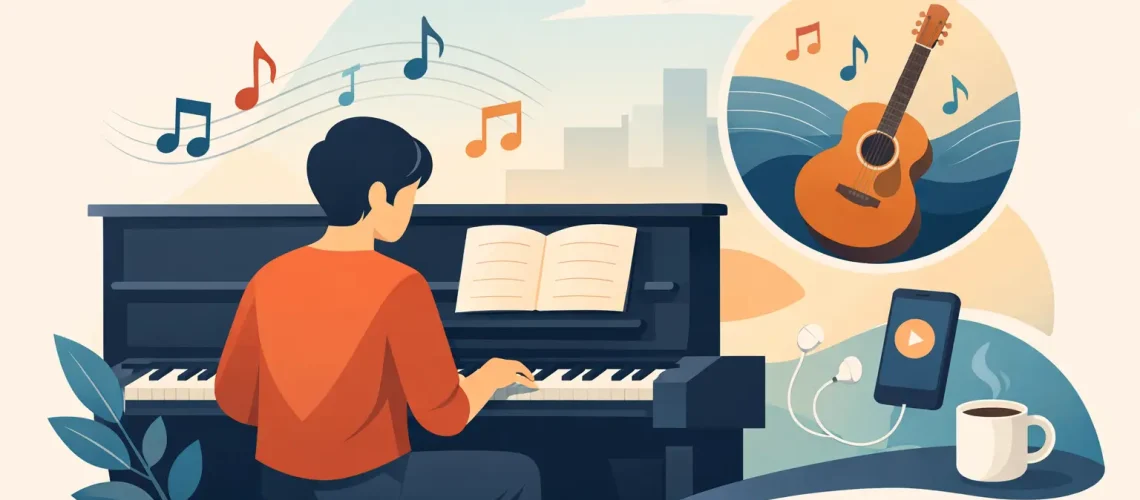
Adult piano lessons are not about proving you should have started at age six. They are about finally sitting down at the keys, playing the song that has been stuck in your head for years, and realizing: this is something you can do.
Maybe you played a little as a kid and forgot nearly everything. Maybe you have never read a note but love Elton John, Billy Joel, Alicia Keys, Radiohead, or the blues. Maybe the piano in your living room has become expensive furniture. Wherever you are starting, the right lesson plan turns curiosity into real progress – without making music feel like homework.
Why Adult Piano Lessons Work Differently
Adult students bring something powerful to the piano: purpose. You usually know why you want to play. It might be stress relief after work, a creative outlet, a way to connect with your kids, or a long-delayed goal that is finally getting your attention.
That purpose matters because piano progress takes consistency. Adults have busy schedules, work demands, family responsibilities, and plenty of reasons to skip practice. A meaningful goal gives each lesson direction. Instead of learning random exercises forever, you can build the skills needed to play music you actually want to hear.
Adults also tend to understand patterns quickly. You may not have youthful free time, but you have life experience, listening skills, and the patience to connect the dots. When an instructor explains why a chord progression works or how a rhythm fits into a song, it can click fast.
The trade-off is that adult learners can be harder on themselves. A wrong note feels bigger when you expect immediate results. Good instruction keeps the standards high while making room for the fact that every musician, including the pros, gets there one repetition at a time.
What You Should Learn First on Piano
The fastest path to playing songs is not skipping the basics. It is learning the basics in a way that immediately shows up in music.
Your first lessons should help you get comfortable with the keyboard layout, hand position, simple rhythms, and note names. You will also begin learning how to read music and chord symbols. These are not separate tracks. They work together. Reading helps you learn unfamiliar music, while chords let you recognize the building blocks behind thousands of songs.
A strong teacher will introduce technique early, too. That does not mean endless scales played at top speed. It means learning to sit comfortably, relax your wrists, use your fingers efficiently, and avoid habits that create tension. Good technique makes playing sound better now and protects your hands as the music gets more demanding.
Within the first four to six weeks, many beginner adults can play recognizable pieces or sections of favorite songs. The exact timeline depends on practice time, prior experience, and the complexity of your goals. But early wins matter. They give you a reason to come back to the bench tomorrow.
Songs and Fundamentals Belong Together
There is a false choice in music education: either you learn songs for fun or you study theory seriously. The best adult piano lessons do both.
If you are working on a classic rock song, you can learn the chord progression, rhythm pattern, melody, and form at the same time. Suddenly, theory is not a worksheet. It is the reason you can predict what comes next, transpose a song into a better key, or play with another musician.
Learning a blues progression can teach timing, chords, improvisation, and listening. Learning a ballad can sharpen control, pedal technique, and dynamics. Every song has something to teach when the lesson has a plan.
How Much Should Adults Practice?
You do not need two free hours every day to make progress. For most beginning adults, 20 to 30 focused minutes several days a week is far more effective than one exhausted marathon on Sunday.
A practical practice session has a simple shape. Spend a few minutes reviewing technique or a short drill, then revisit the song or section from your last lesson. Finish with something enjoyable, even if it is just playing a progression you know well. Ending on a musical win keeps practice from becoming another obligation.
Consistency beats intensity. Ten minutes before work, fifteen minutes after dinner, or a focused half-hour on lunch break can add up quickly. Put the piano somewhere accessible if you can. When the instrument is easy to reach, practice is much more likely to happen.
If your schedule changes every week, talk to your instructor about it. A good teacher can adjust assignments so you always know what matters most. Some weeks are about moving forward. Other weeks are about keeping the groove alive. Both count.
Choosing the Right Teacher for Adult Piano Lessons
The right piano teacher does more than know how to play. They know how to listen, explain, encourage, and adjust the lesson to the person in front of them.
Look for an instructor who asks about your musical taste and goals from the start. If your dream is to play rock, blues, pop, or singer-songwriter music, your lessons should not ignore that for months. You still need foundational skills, but the material should point toward the music that made you want to learn.
It also helps to learn from an active musician. Working performers understand what it takes to keep time, recover from mistakes, play with other people, and communicate through a song. Those skills are especially valuable if you eventually want to play with friends, join a band, or perform for an audience.
At Rawk U, adult piano students learn from musicians who care about the whole experience, not just the next page in a book. The goal is to build confident players who understand what they are doing and feel excited to do it.
Private Lessons Give You a Clearer Path
Apps and videos can be useful practice tools, especially for reviewing a song or keeping rhythm. But they cannot watch your posture, spot a tense wrist, hear why a chord change is stumbling, or choose the next challenge based on how you are progressing.
Private instruction gives you real feedback in real time. It can also save you from spending weeks reinforcing a mistake. For adult beginners, that guidance often makes the learning process less frustrating and much more rewarding.
Performance Is Not Just for Pros
Many adults say they want to learn piano “just for themselves.” That is a great reason to start. You never need to perform publicly to earn the title of musician.
Still, performance opportunities can change the way you play. Preparing one song for a small audience gives your practice focus. It teaches you how to keep going after a missed note, manage nerves, and share something personal without saying a word. Those are skills that reach far beyond music.
A supportive performance environment matters. Your first time should not feel like an audition. It should feel like a milestone worth celebrating, whether you play eight measures, accompany a singer, or perform a full song.
Your First Lesson Should Feel Like a Start, Not a Test
You do not need to arrive with experience, expensive gear, or perfect confidence. You only need curiosity and a willingness to try. A good first lesson should help you meet your instructor, talk honestly about your goals, touch the keys, and leave with a clearer picture of what is possible.
If you are returning after years away, do not measure yourself against who you used to be. If you are brand-new, do not measure yourself against someone who has played for decades. Start with the next note, the next chord, the next small piece of a song.
The piano has been waiting patiently. Book your FREE Trial Lesson, bring the music you love, and learn the art of RAWK – one real song at a time.