A student’s first great lesson usually does not begin with a lecture about scales. It begins with a guitar riff they recognize, a drumbeat that makes them sit up straighter, or the first moment their voice fills the room with confidence. The best music lessons Philadelphia has to offer make that moment happen – then give students the skills to repeat it, improve it, and eventually share it onstage.
Whether you are searching for a child’s first creative outlet, a meaningful activity for a teen, or a way to finally play the songs you have loved for years, the right school should offer more than an hour with an instrument. It should give you a clear path from first notes to real musical confidence.
What Great Music Lessons in Philadelphia Should Deliver
Learning music is exciting, but it is not magic. Students need a teacher who can make the hard parts feel possible: how to hold the instrument correctly, keep time, read notes, build chords, and recover when a song does not go perfectly the first time. They also need a reason to keep coming back next week.
That is why strong instruction balances fundamentals with music students actually want to play. A beginning guitarist might learn a simple rock progression while developing clean fretting and steady strumming. A piano student can work on note reading through a favorite melody. A vocalist can build breath support and pitch while learning how to tell the story of a song.
The goal is not to rush past the basics. It is to put those basics to work right away. When students hear themselves playing a recognizable song within four to six weeks, practice has a purpose. Progress feels real.
The Right Teacher Changes Everything
A music teacher should know their craft. They should also know how to meet a student where they are.
For a seven-year-old beginner, that may mean short, focused challenges, encouragement, and songs that make practice feel like play. For a teenager, it may mean channeling a favorite artist into better technique and stronger musical habits. For an adult returning after years away, it often means replacing self-doubt with a practical plan that respects a busy schedule.
Look for instructors who are active musicians, not just people who can explain a workbook. Working performers understand what it takes to play with other people, handle a missed note, build a set list, and communicate with an audience. They can teach the real-world skills that happen beyond the practice room.
Patience matters just as much as expertise. A great instructor does not make students feel behind because they are new. They help students identify one next step, celebrate the win, and keep building. That kind of personal investment is what turns a nervous beginner into someone who raises their hand for a solo.
Choose an Instrument That Makes You Want to Practice
There is no single “best” first instrument. The best choice is usually the one that keeps the student interested long enough to build momentum.
Guitar is a natural fit for students drawn to rock, blues, pop, and singer-songwriter music. It can be challenging on the fingers at first, but those early chords quickly open the door to hundreds of songs. Bass is a great option for students who love groove and want to become the engine of a band. Drums provide an active, physical way to develop rhythm, coordination, and focus.
Piano gives students a visual map of melody, harmony, and music theory. It works beautifully for beginners of nearly any age and supports many styles. Voice is ideal for students who connect most strongly to lyrics and expression, though good vocal training also requires technique, ear development, and healthy habits.
Parents do not need to solve this decision alone. A trial lesson can reveal a lot: which instrument feels comfortable, which teacher connection clicks, and what kind of music makes a student light up. Sometimes the answer is obvious. Sometimes a student needs permission to try before committing.
Why Performance Belongs in the Learning Process
Private lessons build skill. Performing builds belief.
A student can play a song perfectly at home and still feel completely different when people are listening. That is normal. Learning to perform gives musicians a place to practice courage alongside timing, technique, and musical expression.
Live performance opportunities also make practice more focused. When students know they are preparing for a concert, a band class, or a small showcase, they begin to listen more closely. They learn how to start and end together, stay steady when someone makes a mistake, and support the people playing beside them. Those are music skills, but they are life skills too.
For younger students, a successful performance can create the kind of confidence parents see everywhere else: at school, in social settings, and when trying something unfamiliar. For adults, it can be a powerful reminder that it is never too late to step outside the comfort zone and do something bold.
Performance should be supportive, not intimidating. Students need preparation, clear expectations, and a community that cheers for the effort as much as the final result. A concert is not about producing perfection. It is about giving students a real moment to say, “I did that.”
Private Lessons, Band Programs, and the Best of Both
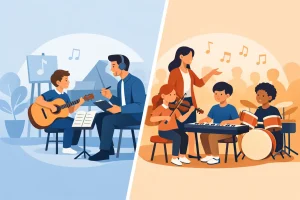
Private instruction is where students build individual technique. They can slow down a difficult measure, ask questions without pressure, and follow a lesson plan tailored to their goals. It is the right foundation for beginners and a valuable home base for advancing players.
But musicians also need other musicians. Group performance programs teach skills that cannot be fully learned alone: following a drummer, listening for a bass line, leaving space for a singer, and adapting when the band takes a song in a new direction.
The strongest learning path often combines both. Students work on their personal skills in weekly private lessons, then bring those skills into a group setting where the music comes alive. At Rawk U, students can take that next step through performance-focused opportunities, including biannual concerts and the six-week Grace the Stage rock band program.
Not every student needs to join a band immediately. A newer player may need time to get comfortable first. Still, it helps to choose a school with a clear performance path available when they are ready. The option gives lessons a destination beyond the next page in a book.
What Parents Should Ask Before Enrolling
Before choosing a program, ask what a typical student can expect in the first month. Will they learn recognizable music? Will the teacher explain what to practice at home? Are fundamentals like rhythm, note reading, technique, and music theory included rather than skipped?
It is also worth asking about the school’s approach to scheduling and commitment. Month-to-month enrollment can be a smart option for families who want consistency without feeling locked into a long contract. A free trial lesson lowers the stakes even further. It gives the student a chance to meet the teacher, try the instrument, and see whether the environment feels right.
Finally, ask how the school supports different ages and goals. A child who wants to play their first concert needs a different plan than an adult learning acoustic guitar for the living room. Both deserve thoughtful instruction, measurable progress, and music that feels personal.
Make the First Lesson Count
Starting music lessons does not require prior experience, natural talent, or a house full of expensive gear. It requires curiosity and a place where students are challenged with care. The first lesson may be one chord, one beat, or one phrase sung with more confidence than expected. That is enough to begin.
Book Your FREE Trial Lesson, bring the songs that inspire you, and give yourself or your child a chance to make some noise. The stage is not reserved for people who already feel ready. It is where readiness gets built.