
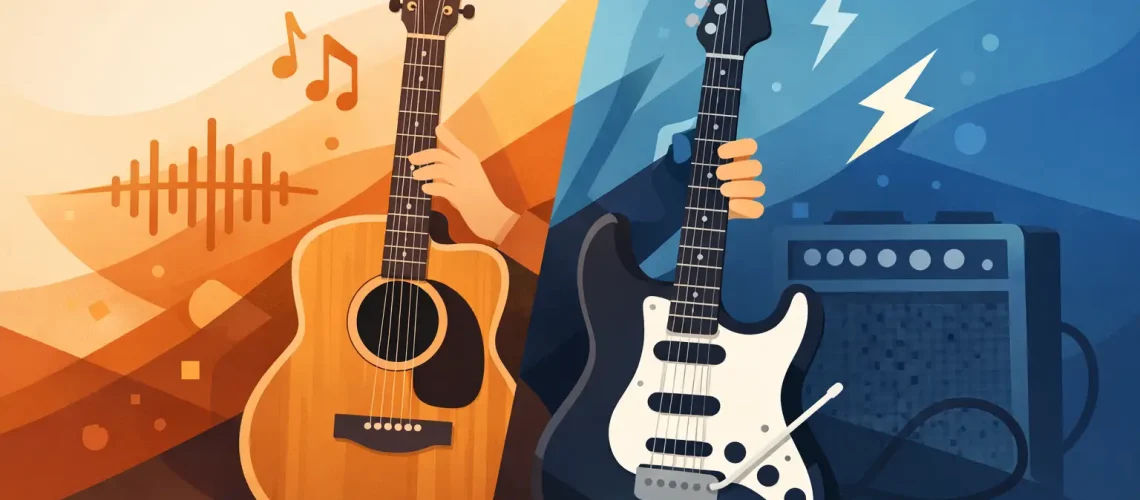
That first plugged-in chord can be a surprise. Your hands know the shape, but the amp makes every extra string ring out, every missed mute show up, and every bend ask for confidence. Electric guitar lessons for acoustic players help turn that moment from intimidating into exciting – while building on the rhythm, chord knowledge, and musical instinct you already have.
You are not starting over. You are switching tools. Acoustic guitar gives you a strong foundation in timing, fretting, strumming, and song structure. Electric guitar opens up new sounds, lighter-feeling strings, expressive bends, lead playing, and the kind of volume that can carry a band. The goal is to keep what you already do well and add the skills that make an electric guitar feel like your instrument.
What Acoustic Players Already Bring to Electric Guitar
Acoustic players often underestimate their head start. If you can keep a steady rhythm through a song, change chords cleanly, and listen for the beat, you already have skills that matter on every stage.
Your chord vocabulary transfers directly. Open chords, barre chords, power chords, seventh chords, and movable shapes still work. So does your ability to support a singer, follow a progression, and recognize when a song needs energy or space. Many students can begin playing recognizable electric-guitar songs within four to six weeks because they are not learning music from scratch.
The biggest adjustment is not learning more chords. It is learning control. On acoustic, a broad strum can sound full and warm. On electric, that same strum through an amp can sound muddy or noisy. You will learn to choose which strings belong in a chord, control ringing strings with both hands, and make rhythm parts sound tight with a drummer and bassist.
Electric Guitar Lessons for Acoustic Players: What Changes
The electric guitar is more sensitive than an acoustic. That is a good thing, but it asks you to be more deliberate.
Your fretting hand needs a lighter touch
Electric strings are usually lighter, and the action may feel lower. You do not need to press as hard as you would on many acoustics. Pressing too hard can pull notes sharp and tire out your hand. A great teacher will help you find the minimum pressure needed for a clear note, then build relaxed technique from there.
This lighter touch is especially important when you start bending. A bend is not just pushing a string upward. It is aiming for a pitch. You might bend a note up a half step or whole step, then use your ear to make sure it lands in tune. That sound is central to blues, rock, pop, and countless guitar solos.
Muting becomes part of your sound
On electric guitar, silence is as useful as sound. Palm muting gives rock rhythm guitar its punch. Left-hand muting stops unwanted strings from ringing. Controlled rests make a riff feel bigger when it comes back in.
This is where acoustic players can make fast progress. You already understand rhythm, so now you can focus on the details that make a rhythm part sound professional: short versus sustained notes, clean stops, accents, and where the groove sits against the drums.
Pick attack matters more than you expect
An amp amplifies your touch, not just your guitar. Picking close to the bridge creates a brighter, sharper sound. Picking closer to the neck softens it. A heavy attack can make a riff hit hard; a lighter attack can make a melodic line sing.
You do not need a pile of gear to learn this. A basic electric guitar, a comfortable pick, and a dependable practice amp are enough to build strong fundamentals. Effects can be fun, but distortion will not cover up weak timing or unclear notes. Start with a clean or lightly driven sound often enough to hear what your hands are really doing.
Build Lead Skills Without Abandoning Rhythm
Some acoustic players assume electric guitar means playing flashy solos all the time. Not quite. Great electric players know how to hold down a groove, add a hook, play a simple fill, and leave room for the rest of the band.
Start with the minor pentatonic scale and learn it as a map, not a box to race through. Play a few notes, then answer yourself with another phrase. Bend one note, add vibrato to another, and leave a beat of silence. This teaches musical phrasing instead of turning every solo into a string of scale notes.
At the same time, keep developing rhythm guitar. Learn power-chord progressions, eighth-note and sixteenth-note patterns, palm-muted riffs, and chord inversions higher on the neck. In a band setting, these skills are often what make a guitarist dependable.
A good lesson balances both sides of the instrument. One week, you may work on the riff and solo section of a favorite rock song. The next, you might tighten your chord timing, learn why the progression works, or practice reading a rhythmic figure. Songs make the work exciting; fundamentals make it stick.
Learn the Fretboard in a Way That Helps You Play
Acoustic players sometimes know plenty of chord shapes but feel lost when asked to name notes above the fifth fret. Electric guitar gives you a reason to change that.
Learning the notes on the sixth and fifth strings first makes it easier to find power chords, barre chords, and root notes anywhere on the neck. From there, connect familiar chord shapes to the notes inside them. If you know a G chord shape, learn where the G notes are. If you play an E minor pentatonic shape, identify the E notes that make it home.
Music theory should make your favorite songs easier to learn, not feel like homework. Knowing why a riff works can help you transpose it, write your own variation, or communicate with other musicians at rehearsal. That confidence is especially valuable when it is time to play live.
Practice for the Sound You Want on Stage
A focused 20-minute practice session beats an unfocused hour. Begin with a few minutes of relaxed warmups, then spend time on one technical goal: clean bends, alternate picking, palm muting, or a chord change that keeps falling apart. Finish by playing a song section from beginning to end without stopping.
Recording yourself is one of the quickest ways to hear progress. Your timing may feel solid while you are playing, but a phone recording can reveal rushed transitions, strings that ring too long, or a bend that misses the pitch. That is not a reason to get discouraged. It is useful feedback, and it gives your next practice session a clear target.
If you are practicing with backing tracks, do not always choose tracks that hide mistakes. Use slower tempos sometimes. Count in before you begin. Listen for the snare drum and make your rhythm part lock with it. The goal is not to sound busy. The goal is to sound like someone other musicians want to play with.
Why In-Person Coaching Makes the Transition Faster
Videos can show you a lick. A skilled teacher can catch the wrist tension, picking angle, muting issue, or timing habit that keeps that lick from sounding right. They can also tailor the path to your goals. A student who wants to play blues leads needs a different focus than a student preparing to join a rock band, support a singer, or play modern pop songs.
At Rawk U, electric guitar students learn with working musicians who understand what happens beyond the practice room. Lessons combine technique, theory, note reading, rhythm, and songs you genuinely want to play. As your confidence grows, performance opportunities can give those new skills a real destination – from playing with others to stepping onto a live stage.
The shift from acoustic to electric is not about becoming louder or playing faster. It is about becoming more expressive, more precise, and more ready to make music with other people. Bring the rhythm you already own, give yourself permission to make a little noise, and book your FREE Trial Lesson when you are ready to learn the art of RAWK.