
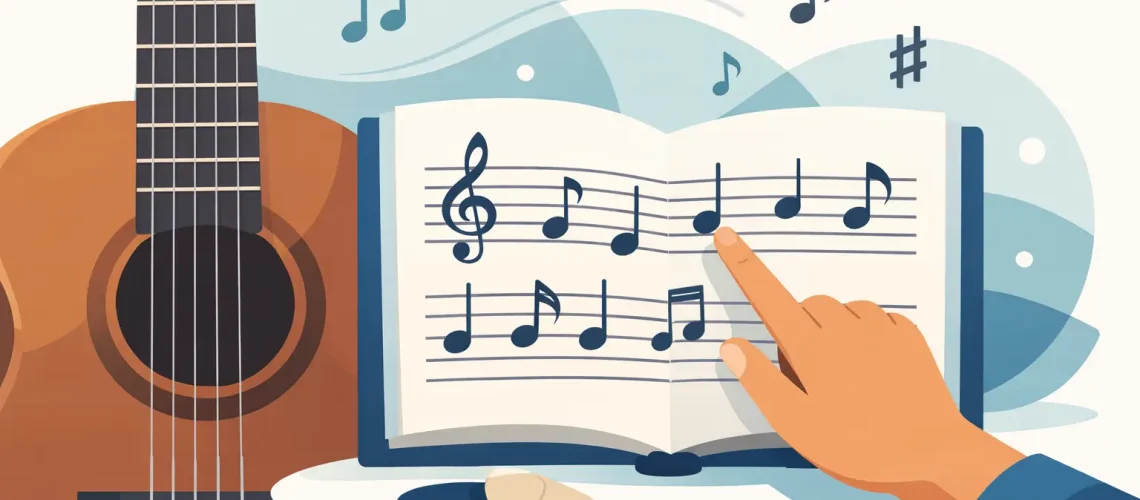
A guitar part can look intimidating when it is written on five lines instead of six strings. But learning how to read guitar notes is not about memorizing a giant pile of symbols before you get to play music. It is about connecting three things: what you see on the page, where the note lives on your fretboard, and how it sounds when you play it. Once those connections start clicking, songs become easier to learn, riffs make more sense, and you can walk into a rehearsal with more confidence.
For beginners, this process should feel musical from day one. You might be reading a simple melody from a favorite song while building the same skills that will help you learn solos, understand chords, and communicate with other musicians later.
Start With the Musical Alphabet
Guitar notes use the same musical alphabet as every other instrument: A, B, C, D, E, F, and G. After G, the alphabet repeats at A. There are also sharps and flats between most natural notes. A sharp raises a note by one fret, while a flat lowers it by one fret.
On guitar, every fret moves you one half step. If you play an open low E string, the first fret is F, the second fret is F sharp, and the third fret is G. There is no sharp or flat between B and C, or between E and F. That small detail saves a lot of guessing.
Before trying to read music on the staff, get comfortable saying note names out loud as you play them. Start on one string. For example, play the notes from open A through the fifth fret: A, A sharp or B flat, B, C, C sharp or D flat, D. Your fingers are learning the pattern, but your ears and brain need to learn it too.
Know Your Open Strings
The six open strings are the foundation of the fretboard. From lowest sounding string to highest, they are E, A, D, G, B, and E.
You do not need a goofy phrase to remember them forever, although one can help at first. What matters more is knowing which E is which. The thickest string is low E. The thinnest string is high E. They share a letter name, but they sound two octaves apart.
Treat these open strings like home base. When you know an open string, you can find nearby notes by moving fret by fret. If you know the fifth fret on the low E string is A, you also know the seventh fret is B and the eighth fret is C. The fretboard is full of repeating patterns, not random facts.
How to Read Guitar Notes on the Staff
Standard notation is written on a staff made of five lines and four spaces. Each line and space represents a pitch. The higher the note appears on the staff, the higher it sounds.
Guitar music is usually written in treble clef, the curled symbol at the beginning of the staff. A useful beginner landmark is the note E on the bottom line. That is the open high E string. The space just above it is F, then the next line is G, followed by A, B, C, and beyond.
Here are several early landmarks worth learning before you attempt every note on the page:
- The bottom line is E, matching the open high E string.
- The second line is G, which you can find on the third fret of the high E string.
- The middle line is B, found on the open B string.
- The fourth line is D, found on the third fret of the B string.
- The top line is F, found on the first fret of the high E string.
These landmarks give you reference points. Instead of stopping to recite a mnemonic every time, notice whether the next note moves up, down, or stays the same. Reading becomes much faster when you recognize motion between notes.
One guitar-specific wrinkle: guitar music sounds one octave lower than it is written. Do not let that derail you. The notation still tells you the correct fretboard note to play. For most students, the practical goal is to read and perform the part accurately, not get stuck in the technical labeling.
One Written Note Can Have More Than One Home
Unlike piano, the guitar has duplicate notes in several places. Middle C can be played on the third fret of the A string, the eighth fret of the low E string, the fifth fret of the G string, and other positions farther up the neck.
That is a strength, but it creates a choice. The written note tells you what pitch to play, while the musical context often tells you where to play it. A low, easy melody may work best near open-position chords. A lead line may belong higher on the neck to match the tone, phrasing, and hand position of the song.
Early on, use the fingering or position markings your teacher gives you. As you gain experience, you will start choosing locations based on tone and efficiency. That is real musicianship, not a shortcut.
Rhythm Is Half of Reading Music
A player can find every correct note and still make the song fall apart if the rhythm is off. Reading guitar notes means reading timing too.
Look at the note head, stem, and flags. A whole note lasts four beats in common time. A half note lasts two beats, a quarter note lasts one, and eighth notes divide a beat in half. Rests matter just as much because silence is part of the groove.
Do not try to solve pitch and rhythm at full speed all at once. First, clap the rhythm while counting out loud: “one, two, three, four” for quarter notes, or “one and two and” for eighth notes. Then play the rhythm on a single note or muted string. Finally, add the written pitches.
This approach might feel slower for five minutes, but it is much faster than repeatedly restarting a passage that your hands have not fully understood. Rock, blues, pop, and funk all depend on solid time. The notes only hit hard when the rhythm is steady.
Standard Notation and Tabs Work Better Together
Guitar tablature, or tabs, uses six lines to represent the six strings. The numbers tell you which fret to play. Tabs are direct and useful, especially when a part uses bends, slides, hammer-ons, pull-offs, or a very specific neck position.
Standard notation tells you the pitch and rhythm with more detail. Tabs tell you a practical location. When they appear together, use both. Read the note value and rhythm from the staff, then use the tab number to confirm the string and fret.
Tabs alone can get you playing a riff quickly. Standard notation helps you understand what you are playing, transpose ideas, recognize melodies, and work with musicians who do not rely on tabs. There is no need to choose one system forever. Strong guitarists can use each one when it serves the song.
A Practice Routine That Builds Real Reading Skills
Ten focused minutes a day can move note reading forward faster than one frustrated hour every Saturday. Keep the work short enough that you can stay accurate and consistent.
Begin by naming five to 10 notes in one fretboard area, such as the first five frets. Then read a short melody at a slow tempo. Keep your eyes slightly ahead of your fingers when possible. If you make a mistake, do not immediately speed up or start over from the beginning. Find the measure where the issue happened, clap it, play it slowly, and repeat it correctly a few times.
Use a metronome, but set it low enough to win. A clean melody at 60 beats per minute is more valuable than a messy one at 110. Increase the tempo only when the notes, rhythm, and hand position feel controlled.
Also, read music you actually want to hear. A simple hook, a vocal melody, or a recognizable guitar line gives the symbols a purpose. At Rawk U, students build foundational skills while applying them to songs they are excited to play, because reading becomes more motivating when it leads to music you can share.
Common Roadblocks and What to Do Instead
The biggest roadblock is trying to memorize the entire fretboard in a weekend. Start with open strings and one position, then add a few anchor notes every week. Progress compounds when you can recall notes quickly instead of cramming them.
Another common problem is staring at your fretting hand. Looking down is normal at first, especially for younger players and adult beginners. But practice brief moments of looking at the page, then checking your hand only when needed. Your sense of touch will improve with repetition.
Finally, do not confuse reading slowly with failing. Even great players read unfamiliar music carefully at first. The goal is not to prove you are fast. The goal is to turn unfamiliar notes into a musical performance, one clear beat at a time.
The next time a page of notation lands on your music stand, do not treat it like a test. Treat it like a map to a song waiting to come alive. Start with one line, keep the beat, and let each correctly played note prove that you are building the skills to step out of the practice room and onto a stage. When you are ready for guidance from a working musician who will meet you where you are, Book Your FREE Trial Lesson and Learn the Art of RAWK!